
On-Site Audiometric Testing for OSHA Hearing Conservation Programs
If your employees work around noise, OSHA expects you to know whether their hearing is changing over time. Safety Consultants USA handles audiometric testing (audiograms) right at your facility. Our safety advisors bring the equipment, test your people, and get your records where they need to be.
No mobile van in the parking lot. No sending employees off-site to a clinic. No sound booth.
What Is an Audiogram?
An audiogram is a hearing test that measures the quietest sounds a person can hear at different pitches. In a hearing conservation program, enrolled employees receive a baseline audiogram within 6 months, then an annual audiogram compared to the baseline. That comparison is how you catch hearing changes early, while there’s still time to adjust hearing protection. Noise-induced hearing loss is permanent, so catching it early is the whole point.
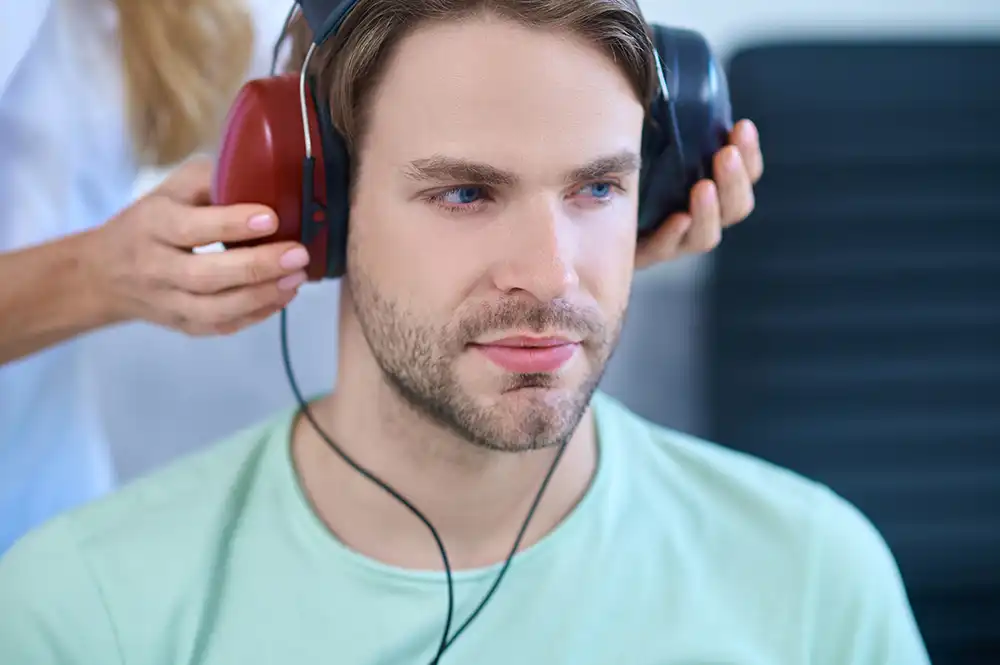
How Our On-Site Audiogram Service Works
We use a tablet-based Class II audiometer that’s clinically validated for use outside a sound booth. It’s ANSI-compliant, FDA listed, and built to meet OSHA requirements for occupational hearing testing. It also has ambient noise monitoring built in, so it keeps track of background noise in the room while each test runs. Results sync to a secure web portal for recordkeeping and compliance reporting.
Here’s what a testing day looks like:
- We schedule with you. We set a date and time that works around your shifts so production keeps moving.
- You set aside a quiet room. More on that below.
- Our safety advisor tests employees one at a time. Each test takes about 10 minutes on average per person.
- Results get reviewed. Annual tests are compared to each employee’s baseline, and any standard threshold shifts are flagged for retesting and recordkeeping.
- You get your records. Reports and employee results are delivered electronically.
On-Site Only, Performed by Our Safety Advisors
This is an on-site service. We don’t run mobile vans, and we don’t send your employees to an outside clinic. One of our own safety advisors comes to your location and runs every test.
Since it’s our team doing the testing, it fits right in with the rest of your safety program. The same company handling your inspections and training can handle your hearing tests too.
What You Need to Provide: A Quiet Room
You don’t need a sound booth, but you do need a relatively quiet space. An empty office, conference room, or training room usually works fine. A few things help:
- A door that closes
- Away from the production floor, compressors, loud HVAC units, forklift traffic, and overhead paging
- A table, 2 chairs, and a power outlet
- Phones silenced and no foot traffic while testing is going on
OSHA sets maximum background noise levels for rooms used for audiometric testing. The Shoebox system monitors room noise during each test, which helps make sure your results hold up. If the room gets too loud, we’ll know right away and can retest.
One more thing for baseline tests: employees should go 14 hours without workplace noise exposure before their baseline audiogram. Wearing hearing protection can count toward that. Scheduling baselines at the start of a shift is the easiest way to handle it.
Who Needs Audiometric Testing?
Under OSHA’s noise standard (29 CFR 1910.95), employers are required to implement a hearing conservation program, including audiometric testing, implement engineering and administrative controls and provide PPE for any employee exposed to noise at or above 85 decibels (dBA) averaged over an 8-hour workday. OSHA calls that the action level.
That covers a lot of workplaces, including manufacturing, metal fabrication, woodworking, food processing, warehousing and distribution, printing, utilities, and construction.
Not sure if your employees are over the action level? We can provide noise dosimetry to assess the noise levels in your facility.
OSHA Audiometric Testing Frequency Requirements
Here’s how often OSHA requires testing for employees in a hearing conservation program:
| Test | When | Details |
|---|---|---|
| Baseline Audiogram | Within 6 months of an employee's first exposure at or above the action level. | If a mobile test van is used, employers get up to 1 year, but employees must wear hearing protection after 6 months until the baseline is done. Requires 14 hours without workplace noise beforehand. |
| Annual Audiogram | At least once a year after the baseline. | Compared to the baseline to check for a standard threshold shift. |
| Retest (Optional) | Within 30 days of an annual test that shows a shift. | The retest can be used as the annual audiogram. Retesting is recommended to be performed by an audiologist. |
What Is a Standard Threshold Shift?
A standard threshold shift (STS) is an average change of 10 dB or more at 2000, 3000, and 4000 Hz in either ear compared to the employee’s baseline. OSHA allows an age correction when figuring this out.
When an STS shows up, the employer has to:
- Notify the employee in writing within 21 days
- Fit or refit hearing protection, train the employee on how to use it, and require them to wear it
- Refer the employee for a clinical or medical evaluation.
An STS can also be recordable on your OSHA 300 log if the employee’s hearing level in that ear is 25 dB or more above audiometric zero (averaged at 2000, 3000, and 4000 Hz).
Recordkeeping
Audiometric test records are required to keep for the length of the employee’s employment and recommended to maintain 30 years thereafter. Noise monitoring records are required to be maintained for 2 years.
What About Construction?
OSHA’s construction standard (29 CFR 1926.52) requires a continuing, effective hearing conservation program when noise exposures are over the limit, but it doesn’t spell out a testing schedule. Most contractors follow the general industry schedule above, and a lot of GCs and owners require it on their jobs. We test construction crews too.
What You Get
- Baseline and annual audiograms for each employee tested
- Annual results compared to baseline, with standard threshold shifts flagged
- Employee notification for any shifts
- Records stored in a secure online portal and ready for an OSHA inspection or client audit
Why Companies Use SCUSA for Audiograms
- Less downtime. Employees test on-site in a few minutes and get right back to work.
- No van to schedule or park. Just an empty office.
- One safety partner. Your hearing tests fit in with the inspections, training, and programs we already handle.
- Nationwide coverage. Safety Consultants USA has been doing this since 2008, with 8 regional offices serving clients in all 50 states.
Frequently Asked Questions
Do we need a sound booth for audiometric testing?
No. We use SHOEBOX PureTest, which is clinically validated for testing outside a sound booth. You just need a relatively quiet room like an empty office or conference room.
Is boothless hearing testing OSHA compliant?
Yes. OSHA doesn’t require a booth. It requires the test room to stay under set background noise levels and the audiometer to meet ANSI standards. The Shoebox system monitors room noise during every test.
How often do employees need a hearing test?
Employees in a hearing conservation program need a baseline audiogram within 6 months of their first exposure at or above 85 dBA, then a new audiogram at least once a year.
How long does each test take?
About 10 per employee.
Do you come to our facility?
Yes. This service is on-site only. One of our safety advisors comes to your location and does the testing.
What happens if an employee has a threshold shift?
The employee gets notified in writing within 21 days. From there, hearing protection gets refit, the employee gets retrained, and they may be referred for further evaluation. We’ll walk you through it.
Can you test construction workers?
Yes. We test crews for contractors, either at your office or ours, but jobsites are typically too noisy.