Know the Important Regulatory Changes and End-User Compliance for the 2026 and 2027 Deadlines
Hazard Communication HAZCOM was OSHA’s second most cited standard in 2025. It is essential to stay current on changes ahead. OSHA announced the Final Rule for the seventh revision of the Globally Harmonized System of Classification and Labelling (GHS) in July 2024. The original compliance deadline of January 19, 2025, has been extended to allow OSHA an additional four months to review and finalize compliance guidance documents.
Deadlines
Tiered deadlines for manufacturers and distributors to evaluate and revise include:
- Substances extension from January 19, 2026, to May 19, 2026
- Mixtures extension from July 20, 2026, to November 29, 2026
- Distributors’ extension from July 19, 2027, to November 19, 2027
If your company is NOT a chemical manufacturer, importer, or distributor, compliance is relatively straightforward. Companies must update their HAZCOM program, Safety Data Sheets, labels, and worker training to reflect the changes. Revision and training dates for end users include:
- Substance by November 20, 2026
- Mixtures by May 19, 2028
Key Regulatory Changes
Key Regulatory Changes applicable to manufacturers, importers, and distributors include:
Changes in Hazard Classifications and Precautionary Statements
Manufacturers must evaluate the health and physical hazards of chemicals in accordance with Appendix A and B, as well as the intrinsic properties. Hazard Classification has been added or updated to include chemicals under pressure. desensitized explosives and flammable gases. Precautionary statements will be revised in accordance with Appendix C. Manufacturers need to consider how a chemical is reasonably expected to be used, as a mixture, and must define these hazard classifications as well.
Safety Data Sheets (SDS)
Section 1: Manufacturers must include a US Domestic address and phone number.
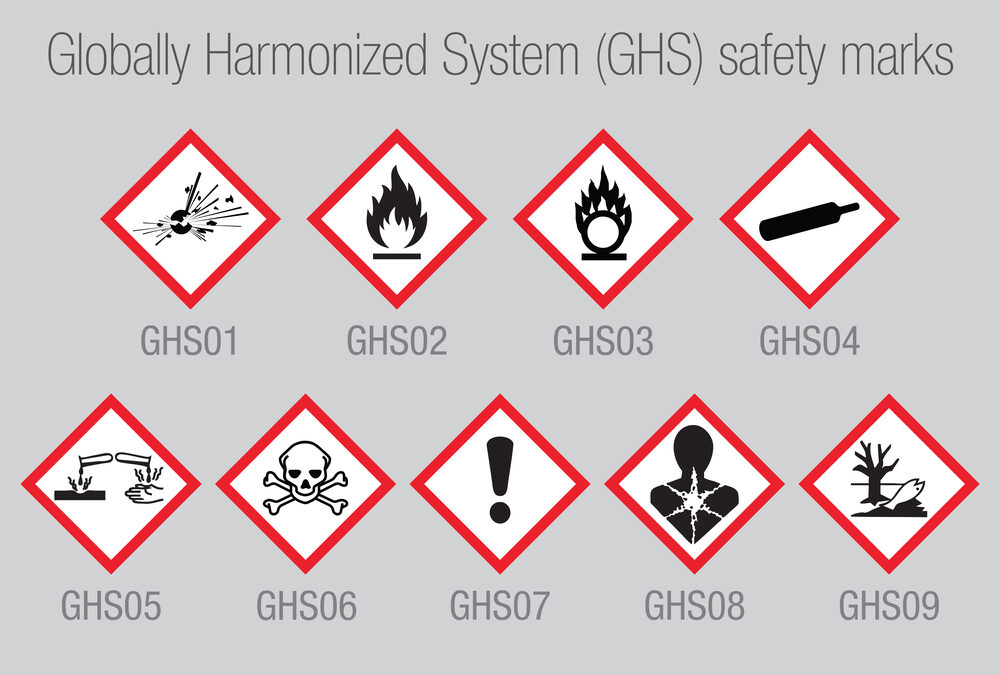
Section 2: Revise the Hazard Statements, Precautionary statements, and pictograms in accordance with the new classifications.
Section 9: Refines particle characteristics to include items to identify combustible dust and nano hazards: Particle size, Particle shape, Aggregation, Surface area, Porosity, and Dustiness.
Labeling small containers
Requirements for small containers 100mL or less and 3mL or less have revisions to improve completeness and readability, including abbreviated labeling based on size – too small to read.
100 mL or less – if a label cannot attach to the container, it must include the full label on the outer package.
3mL or less – no label elements are required if it interferes with use – laboratory environment.
Trade Secret Protections clarified to avoid limiting critical information for workers or first responders.
Compliance for End Users
Safety Data Sheets
Accurate and up-to-date Safety Data Sheets (SDS) start with an accurate Master Chemical Inventory. Companies should begin reviewing inventory now to identify necessary updates. If you currently use a web-based SDS management solution, ensure it accurately reflects your SDS inventory. These programs ensure the revised SDSs are uploaded as they become available from the manufacturer.
If you manually manage your SDS, you will need to establish a process and assign responsibility for receiving new sheets and replacing outdated ones. The outdated sheets are not required to be archived unless you are retiring the chemical. Retired SDS must be archived for 30 years.
Labels
Manufacturers’ labels will be self-adjusting. You should see a shift to new labels as required. There is no requirement to send out new labels for existing supplies. You will label secondary containers in accordance with sections 1 and 2 of the SDS.
Training
If you use chemicals affected by the change, you must provide training by Nov 20, 2026, in accordance with the new deadlines. HAZCOM training may be provided on individual chemicals or based on the classes of chemicals used within your organization
Training is required upon initial assignment to work with chemicals or when changes occur. An annual refresher is recommended. Please let us know your questions and how we can support your training. Call 1.877.723.7622 or complete the training request form below.